A German Companion on Route 66
by Rhys Martin
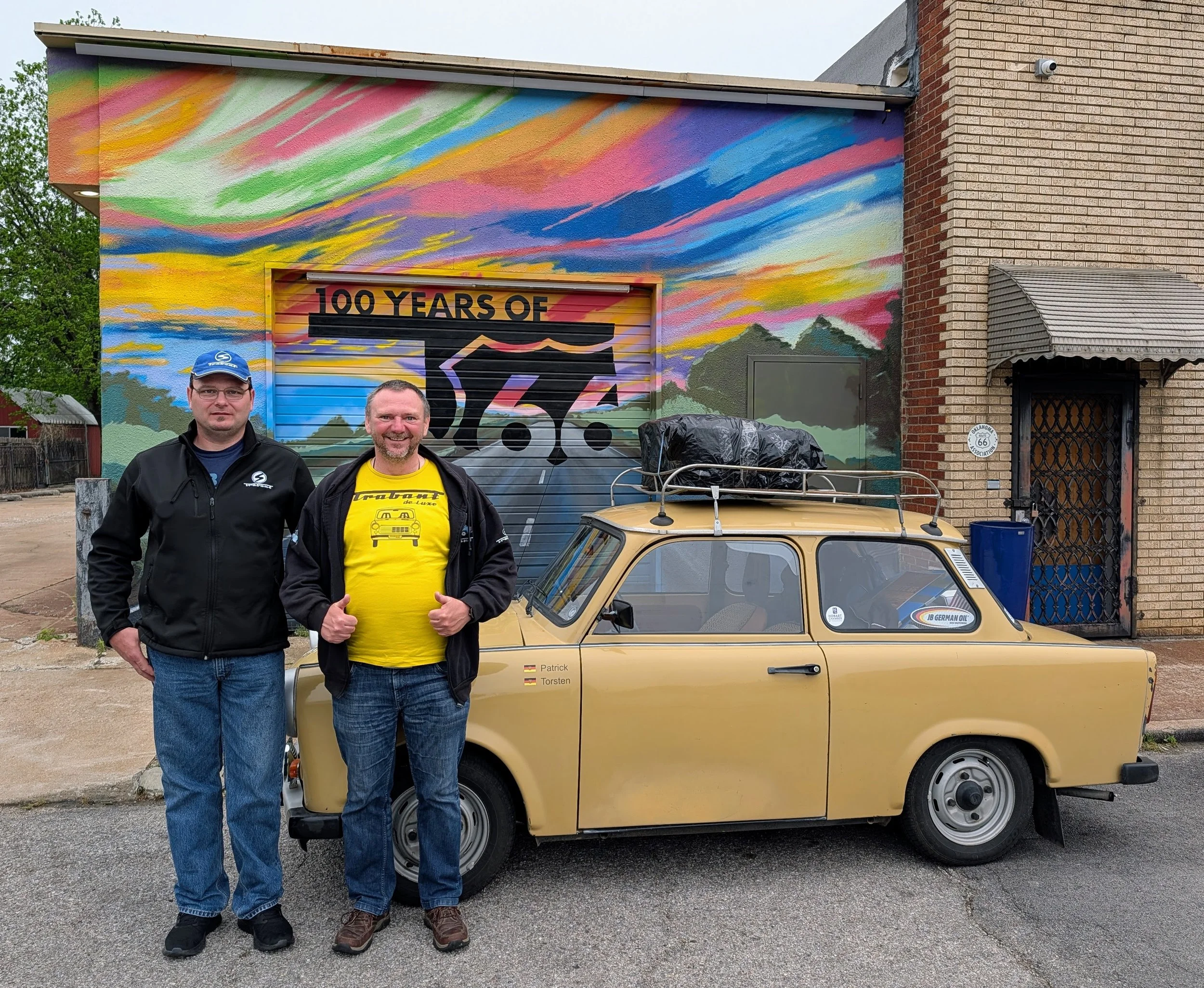
As I stood outside of Sweetie Pie’s Amish Bakery and Café on Tulsa’s stretch of Route 66, I could hear the little car coming. It wasn’t struggling, per se, but the engine just sounded different. Then I saw it: a little two-door car that was nearly identical in color to the city’s famous Golden Driller. I also saw its inhabitants: Patrick Friedrich and Torsten Prasch. They were in the middle of a journey down Historic Route 66 in a vehicle that had quite a history.
The Trabant (which means companion, and it is colloquially known as a Trabi) is a relic of the cold war. These cars were produced in East Germany from 1957 until 1991, shortly after the Berlin Wall fell. Metal was harder to come by on the other side of the Iron Curtain due to embargoes, so the body panels are made of Duroplast. The material was invented in the German Democratic Republic (GDR) in the 1950s and is a plastic fiber material not unlike Formica. The design of the cars remained virtually unchanged in 30 years and became a symbol of the country…in more ways than one.
The cars had to be ordered from the state itself, and it was not an easy process. “When you wanted to have one…you had to wait fifteen years to get it,” Patrick explained. He said that some people would order a car right after a child was born so that perhaps it would be available when they were of driving age. The cars weren’t cheap, either. “Simple workers, maybe earned 300 marks [a month] when the car was about 10,000 marks.” Some would sell off the notes halfway through the waiting period for a profit and a used car went for about twice the money.
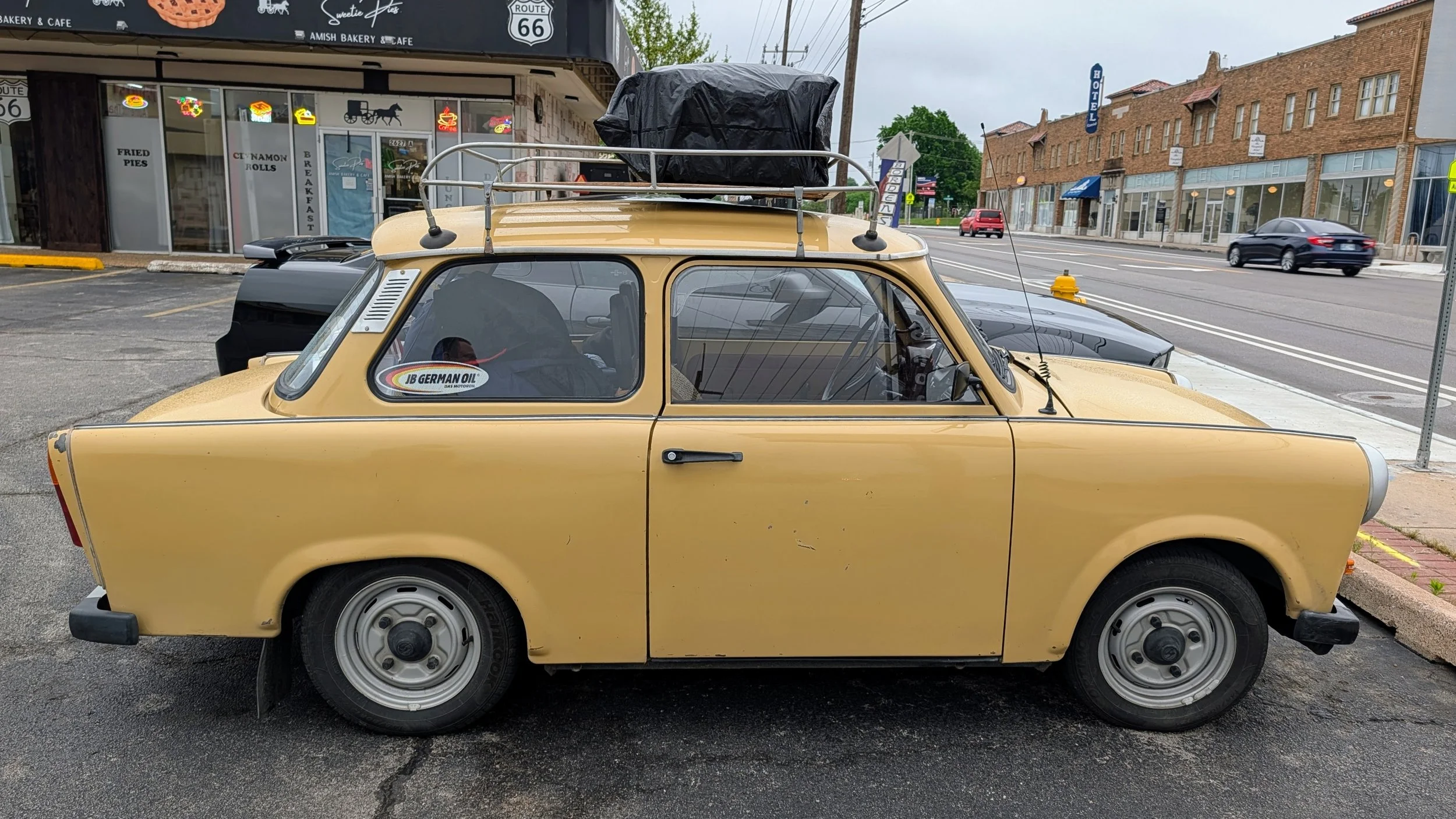
These factors, coupled with the fact that people greatly desired western cars once they had the opportunity, mean that Trabants are relatively rare today. Out of around 3 million produced, only 40,000 or so remain licensed and drivable. But the number is growing as cars are found and restored by enthusiasts.
Patrick and Torsten were both around 20 when communism in Europe collapsed; they lived in western Germany at the time. They told me how hard it was for people to go from a mindset where someone that had been an enemy for 40 years was suddenly supposed to be your friend. Patrick was fascinated by the life that had been on the other side of the wall and moved to the GDR when he had an opportunity, where he fell in love with the Trabant and its history.
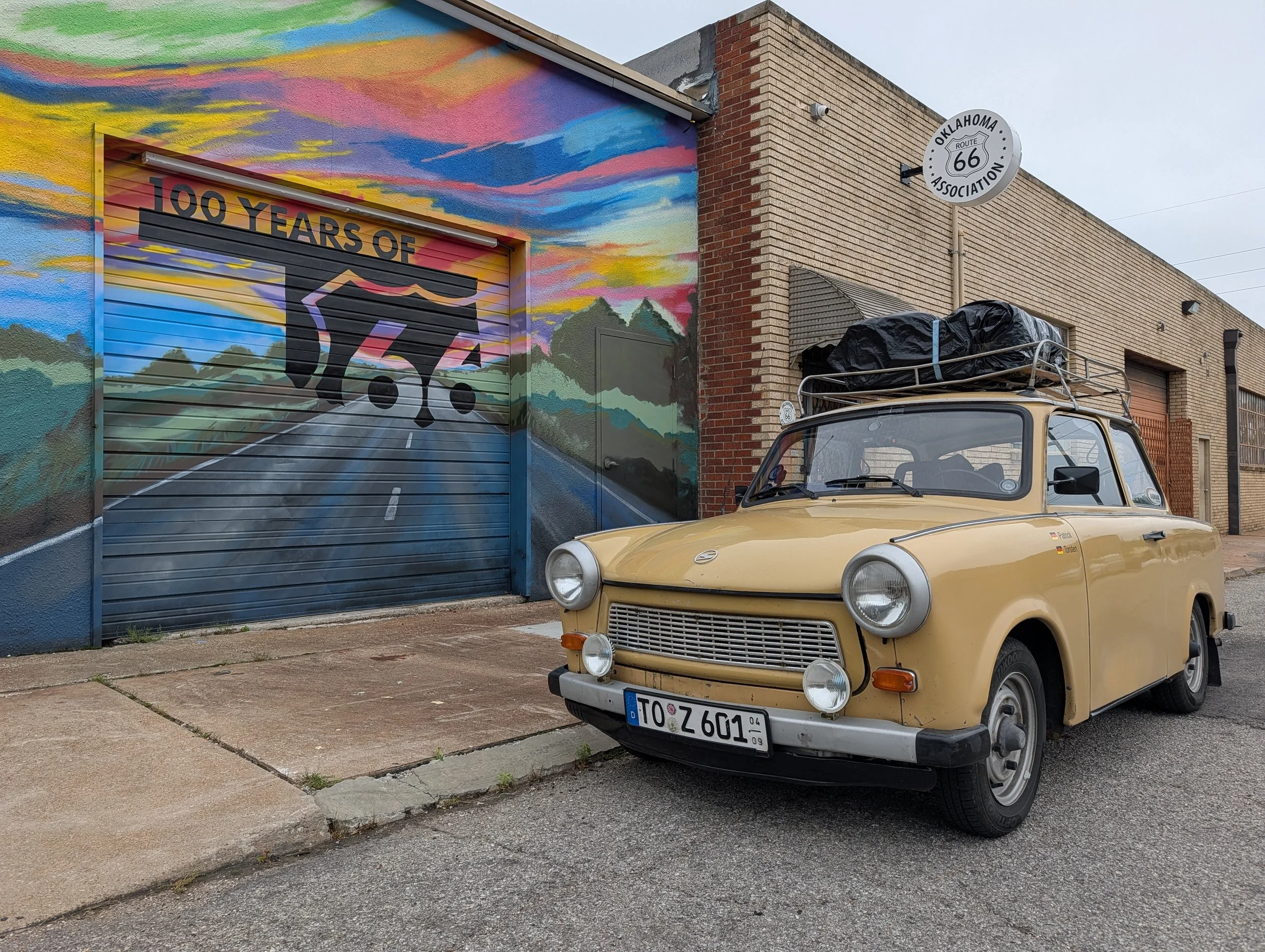
Patrick had been dreaming of a Route 66 trip in a Trabi for decades. Although he was set to realize those dreams a few years ago, COVID was a setback. But then he set his sights on the Centennial year. He connected with a few friends (there’s another Trabi on Route 66 making the journey, too, but its occupants were visiting friends elsewhere on the day they came through Tulsa) and here he was on the most famous road in the world. “There is so much to plan if you make such a trip,” Patrick said, adding how lucky they were that four of them were able to get nearly two months off of work to take the trip.
Two months because the traveling party wanted to take their time crossing the country. Not only because the Trabi’s little air-cooled two-stroke engine averages about 50 miles-per-hour, but because they truly wanted to connect with the places and people that the road led them to. He showed me the itinerary planning document he’d made, which was extensive. He told me about meeting so many wonderful, friendly people like Phyllis Ferguson of the Rockwood Motor Court in Springfield and Rita Kirchoff at the Wagon Wheel Motel in Cuba.
In between bites of breakfast, I asked them how they felt about Route 66 being held up in the United States as a beacon of freedom. Did that ring true to their experience?
“Yes, definitely,” Patrick said. “If you think, years ago, many people came from Europe. They wanted to find a better place to live, because in Europe there had been wars and all that stuff, in such a short time one after the other. They wanted to be rid of this.” Many people found it in America. “They went down Route 66 and stopped somewhere. ‘OK, it’s nice here,’ or they went on to find another place. ‘I’m free to go anywhere and I can do anything. I can be a farmer, or work in fabrication, anything.’ That is freedom, the same as when the Wall came down.” Although the experience was not unique to Route 66, the road’s cultural place in the American story meant that it stood out from the rest.
Our visit certainly gave me a lot to think about as America celebrates its 250th birthday this year, alongside the Route 66 Centennial. I waved goodbye to my new friends as they continued west, with the freedom of the open road reflected in their windshield and stamped upon their hearts.