Bob Waldmire: The Free Spirit of Route 66
by Rhys Martin
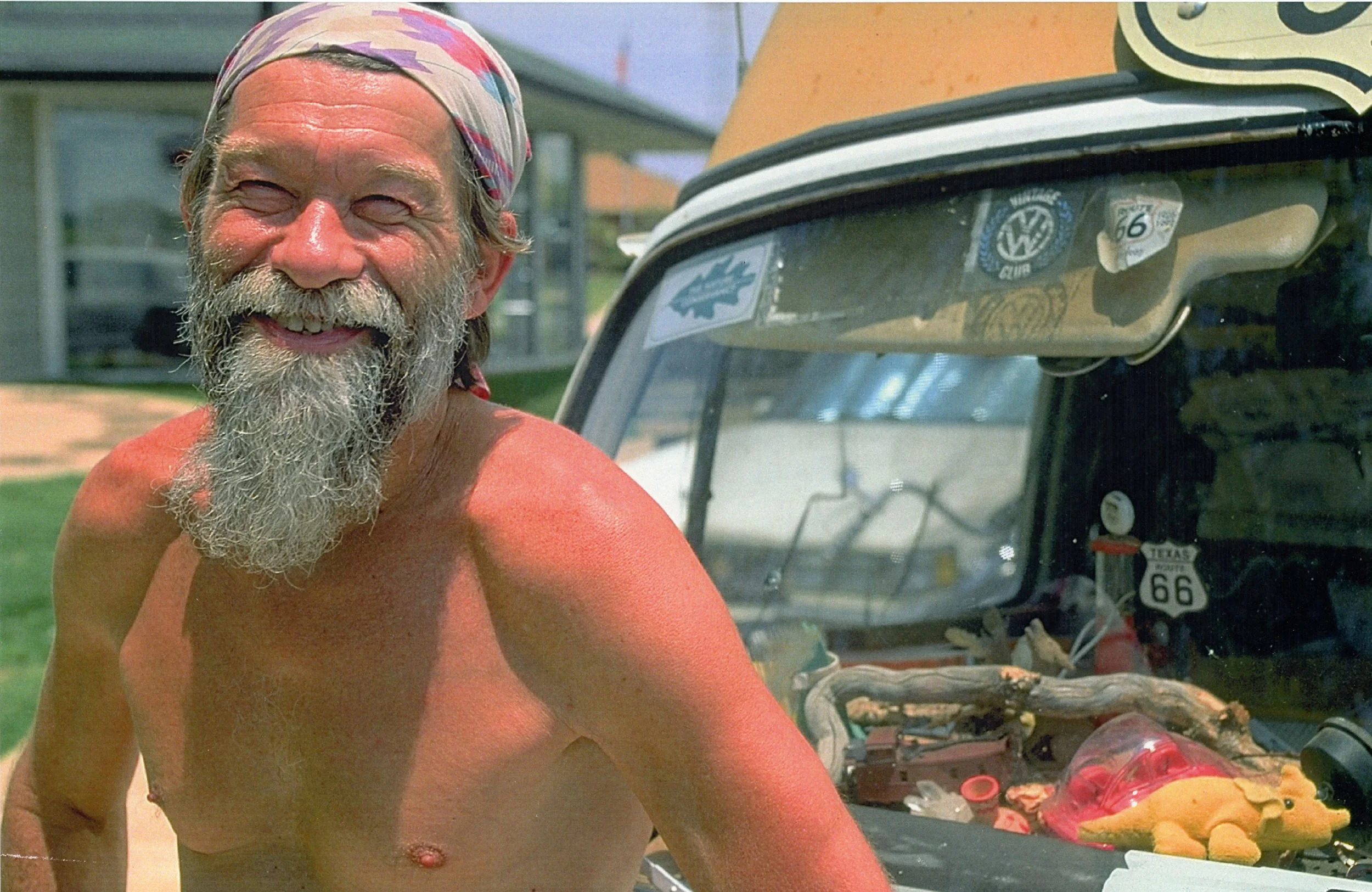
Bob and his bus at the Oklahoma Route 66 Museum in Clinton, Oklahoma - courtesy of Michael Wallis.
This article is one of several included in the Spring Edition of The Chronicles of Oklahoma, which you can see in its entirety here.
Sending postcards back home to friends and family is a simple joy. It may feel a little old-fashioned in today’s digital world, but there’s nothing like getting a piece of physical mail that someone took the time to literally write out and drop in a postbox. Plus, the postcard itself shares a little bit of the place it came from. Most postcards feature a photograph or collage of pictures on the front, but my favorite ones feature artwork. It’s a melding of reality and interpretation.
When I first started exploring Route 66, I noticed a commonality among many gift shops: a particular kind of postcard with beautifully detailed, pen-and-ink hand-drawn depictions of roadside landmarks and natural wonders. I finally asked someone about the artwork and they said proudly, “That’s Bob Waldmire’s work!”
“Who is Bob Waldmire?” I wondered.
That’s an answer that is still unfolding before me after more than a decade of exposure to Route 66 culture and countless trips between Chicago and Santa Monica.
Robert Waldmire was born on April 19th, 1945, in St. Louis, Missouri. Some people knew him as the owner of the Hackberry General Store in Arizona; other people knew him as the inspiration behind the character Fillmore in Pixar’s Cars film franchise. Others knew Bob as a constant presence at festivals, events, and gatherings. But it took more than 40 years for him to embrace Route 66 in a way that would tie him forever to the road’s enduring legacy. He was an artist first and had already amassed quite a body of work by the time he started taking his Volkswagen van on trips down the Mother Road.
In truth, Bob’s connection to Route 66 starts with his father.
Ed Waldmire, Jr., the family patriarch, is credited with inventing the corn dog. He was visiting family in Muskogee, Oklahoma in the early 1940s when he had a batter-covered frankfurter. It was baked and, to Ed, was missing something. He tinkered with ideas while serving in the Army Air Corps in Amarillo, Texas and eventually settled on deep-frying them on a stick. They were an immediate hit on base and when Ed returned home to Springfield, Illinois, he opened the Cozy Dog Drive-In right on Route 66. It’s still operating today.
Bob wasn’t too interested in the family business. He would work there on-and-off over the years, but he was much more interested in exploring the world around him. "We lived two miles north of the Cozy Dog on South Sixth Street," Bob told Route 66 advocate Tom Teague in 1998. "A couple of blocks from us, there was a vacant lot. I would go over there, usually by myself, and poke around under the cardboard and tin, looking for little snakes, spiders, and other critters. At home, Mom would allow me to keep them in the back yard in boxes." When Bob was about 11, the family bought a farm in nearby Rochester and his fascination with the natural world deepened.
Bob’s brother, Buz, recalled that their mother encouraged his creativity from an early age. He wasn’t the only one, either. “My oldest brother, Bill, was also drawing. It kind of runs in the family but Bill ended up working for the state and letting that go. Bob never really had a regular job.” When Bob was a senior in high school, the Waldmires took a family trip to Arizona. He fell in love with the desert immediately, and after graduating he went back to the Grand Canyon State to enroll in summer classes. However, his initial foray into the southwest didn’t last long. He returned home to Illinois, working sporadically at the Cozy Dog while taking botany courses at the local community college. It was during this time that he really began to lean in to art as a form of expression.
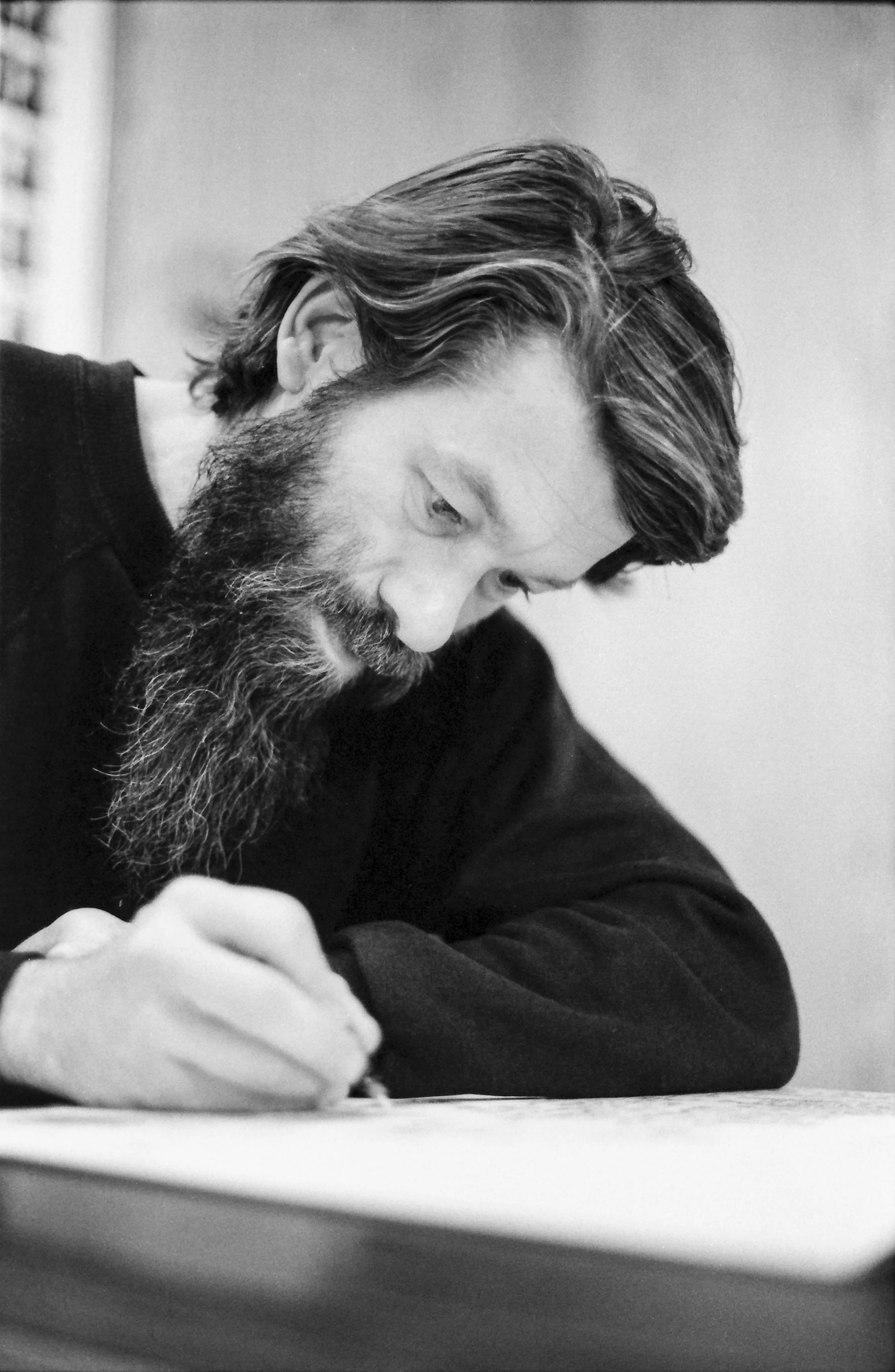
Bob Waldmire, 1982 (Wikimedia Commons)
"I started when I was in high school by lettering menus," Bob continued in his 1998 interview. "I found it gratifying to have my work seen. Later I painted billboards and other signs. My first ones were crude and amateurish, but Dad was not concerned about the level of competency. I have a good eye and a steady hand and in time I became quite good." In 1970, Bob created and sold a birds-eye map of Springfield, Illinois and realized that it was his true calling.
The next year, Bob further embraced his love of the natural lifestyle by becoming a hippie and a vegetarian. That didn’t mesh very well roadside corn dogs. This conflict with his personal beliefs, combined with his wanderlust and growing interest in sketching the world around him, led him back to the road.
Bob would drive from town to town in his 1965 Mustang and set down for a few months. He’d learn about each community, sketch a panoramic poster of the town, and sell it along with his other artwork for pennies, just enough to fill the gas tank. Then he’d hit the road and do the same thing elsewhere. As he honed his skills, his work got denser, tinier, and more detailed. And it set a pace that determined the course of his life.
In Bob’s own words: “Small is beautiful. Slow is beautiful. Old is beautiful.”
After about a year of this, Bob realized his sports car didn’t fit with this nomadic way of living. He traded it in for a Volkswagen station wagon, which also served as his traveling home. This lasted for more than a decade before he traded up to a 1972 Volkswagen camper van. The orange-and-white vehicle would become an extension of Bob himself. He drove east and west across the country, sketching wildlife, cityscapes, and small businesses. Buz Waldmire, one of Bob’s brothers, remembered, “Dad convinced Bob he needed to draw a poster that would appeal to a lot more people than just a city.” So, Bob’s subjects expanded to entire states and regions.
Pro-environment messages would be tucked into larger drawings, such as condemning New Mexico’s role in nuclear energy or decrying inhumane treatment of coyotes in Silver City, Nevada. In time, Bob would create posters for more than thirty towns across fifteen states.
It wasn’t until 1987, two years after Route 66 was federally de-certified, that Bob truly connected with the Mother Road. He was making his way back to Illinois and there was a traffic jam on the interstate. On a whim, he took an off-ramp onto Historic Route 66. The allure of the old highway quickly took hold. “Back on 66, there was this bump-ba-bump-ba-bump as I drove over the poured concrete slabs - a feeling of being closer to the land and nature,” Bob explained in 1998. “Within a few miles, the light bulb lit that I should make a map about the road." He called it A Nostalgic, Bioregionally-flavored Bird’s-Eye-View Map of Old Route 66. “[Bob] told me personally it would take about four months to put that together and finish it,” said Buz Waldmire. It ended up taking more than four years!
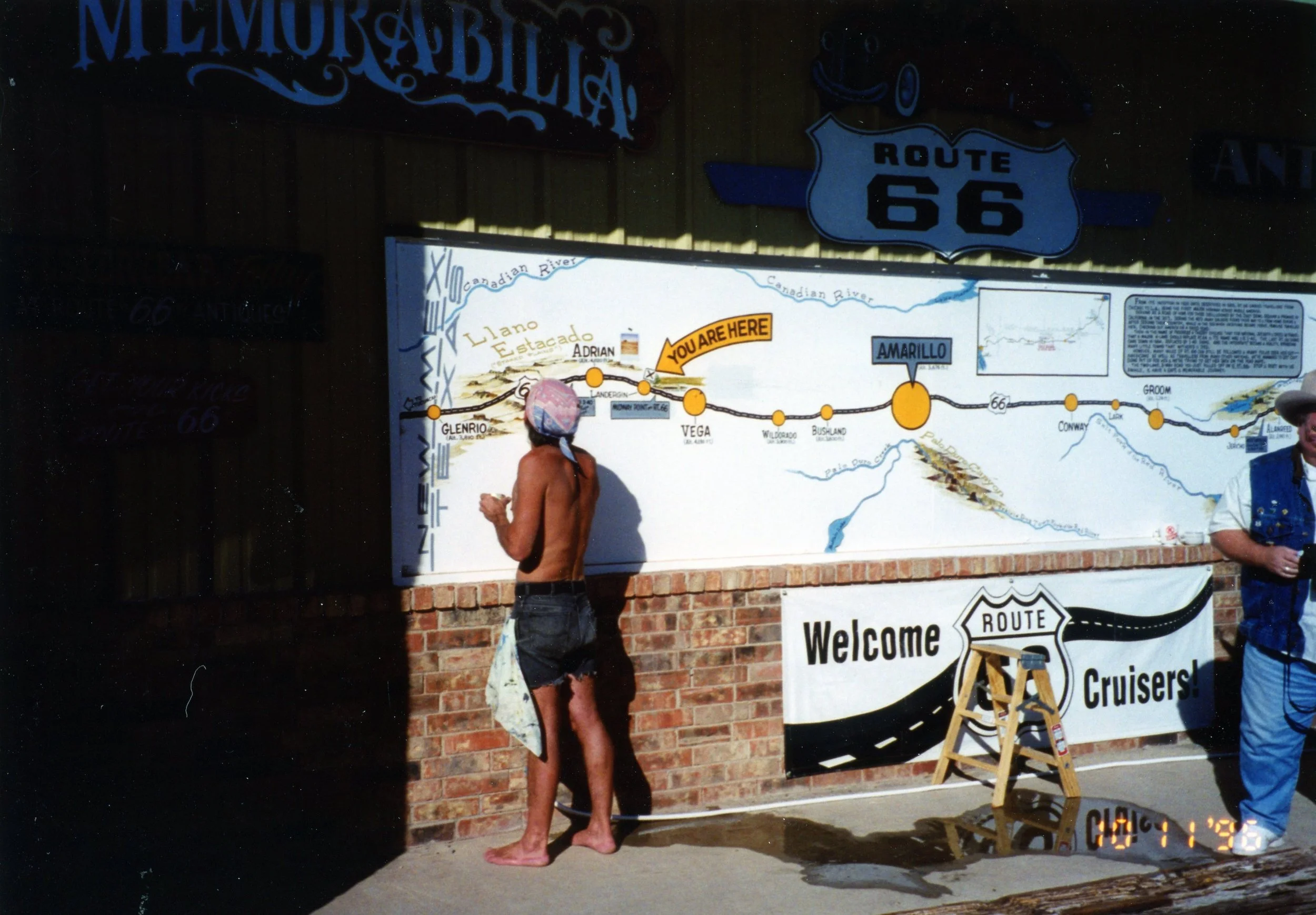
Bob Waldmire painting a mural in Landergin, TX in 1996 (courtesy of the Marian Clark collection)
At the same time Bob was turning his artistic attention to the old highway, there was tremendous progress in recognizing Route 66 as a historic treasure. Angel Delgadillo, a barber from Seligman, Arizona (who coincidentally also celebrated his birthday on April 19th), successfully lobbied the state legislature to designate a stretch of the road as historic. He also helped found the first statewide Route 66 Association. Within two years, all eight states would have their own Association dedicated to preserving the road for future generations. Only one state, Oklahoma, formed their Route 66 Association at the behest of the state government. Also that same year, an old school bus in Grants, New Mexico caught Bob’s eye and he bought it with plans to turn it into a mobile home and studio.
In the spring of 1989, the State of Oklahoma signed into law a resolution directing multiple state agencies to study Old Route 66 and direct the creation of a private non-profit dedicated to the preservation and promotion of the historic road. In the early stages of that work, the state reached out to Bob to create artwork for this new promotional focus. “I just got a call from [the Department of Tourism] in OKC,” Bob wrote in a letter on June 1st of that year. “About doing some work for [them.] He was asked to sketch “sites of interest” along the old road in the Sooner State, which would be used in travel brochures and decorative posters.
For the whole month of November, Bob lived in Oklahoma City and sketched about 40 drawings from the Will Rogers Office Building at the Capitol. These drawings would be used extensively for many years and can still be found on postcards and posters along the route today. He would also take excursions around the metro. On Thanksgiving, he visited the Oklahoma City National Stockyards. Among the human absence of the holiday and a few roosting pigeons, he noted a handful of pigs and lamented their fate. “Perhaps they’re wondering why they’re still here…nothing I can do to tell them how sorry I am, how I wish I could help them,” he wrote at the time.
The full sketch of the entire route that Bob dreamed of in 1987 was finally completed in 1992. The map - which spanned ten pages AND a six page legend - was more than just the road. It included landmarks, geologic formations, flora, and fauna. It was tremendously detailed and it awakened a desire within the artist to be a part of the road’s linear community himself.
Dreams of heading back west on 66 became a reality when Bob bought an old grocery store in Hackberry, Arizona that had been vacant for more than a decade. Like many sites on old Highway 66, it was abandoned after the town was bypassed by Interstate 40. He turned it into the “International Bioregional Route 66 Visitor’s Center” and a landmark for a small but growing audience of travelers and fans of the road.
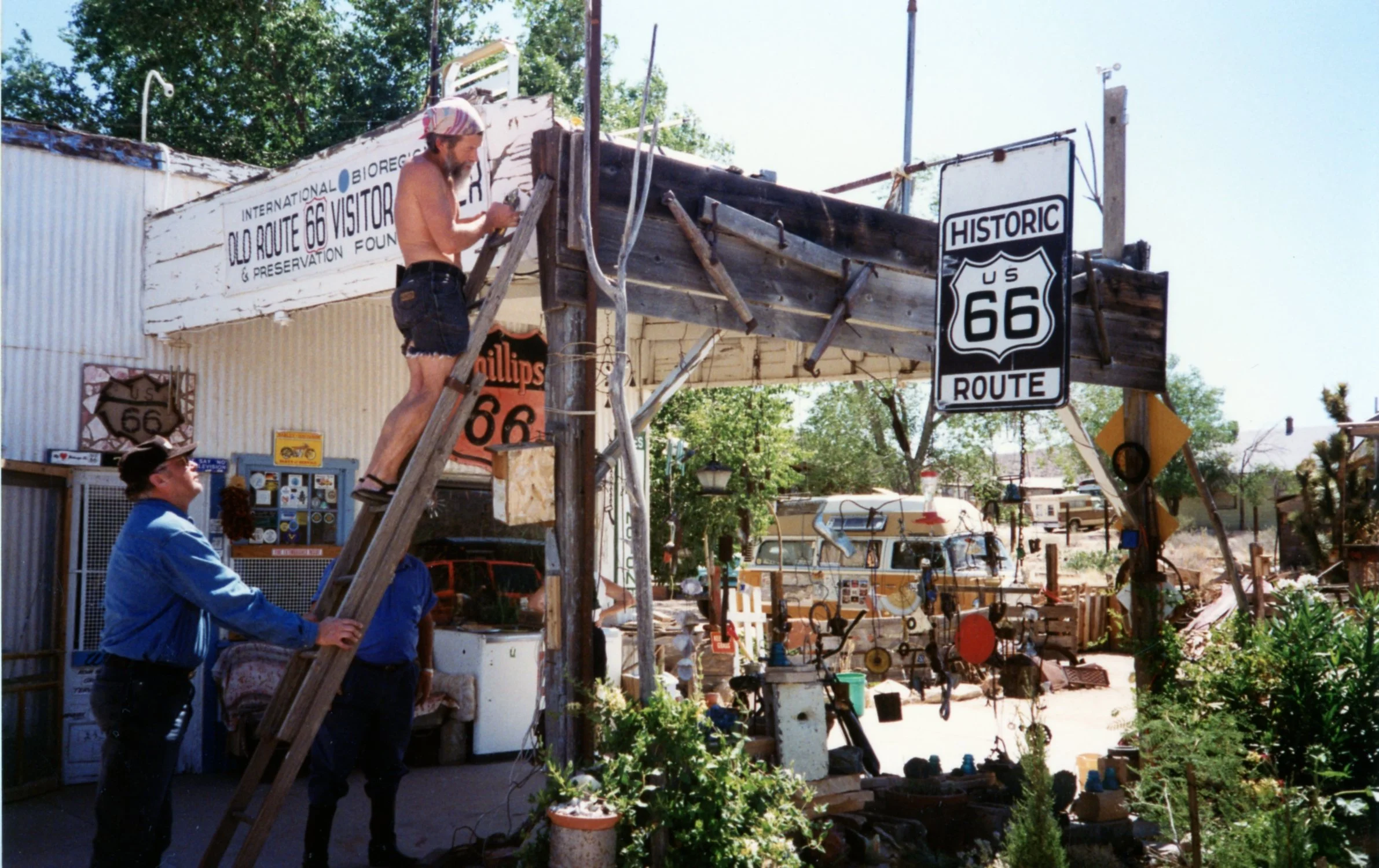
Bob Waldmire working on Hackberry Station, 1996 (photo courtesy of Michael Wallis)
The station during Bob’s tenure was also a collection of his passions. His artwork was available in the form of posters and postcards. His father’s book collection was on display as was a great number of natural displays. It was as full of as much meticulous detail as his drawings were. The station became a popular stop for the growing numbers of international travelers that were looking to experience America of the 20th Century. In his annual Dispatch letter from 1994, Bob wrote, “Visitors from 37 nations have signed the visitor registers here. Route 66 is no trivial destination.”
Back in Illinois, the Chevrolet school bus that Bob had purchased back in 1987 was finally complete. He had successfully converted it into a unique mobile home with a wooden second story added to it complete with sun deck. It also included solar panels, a porch, a rainwater collector, and a self-composting toilet. It was pure Bob Waldmire. And in September of 1995, it made the trip out to Hackberry.
And, yet, Bob’s insatiable wanderlust and connection to nature pulled at him. His occasional trips down to the Chiricahua Mountains for rest and relaxation provided a stark contrast from the busy-and-getting-busier activity on Route 66. The opening of a rock quarry near the General Store was the last straw. After six years rooted in Hackberry, Bob sold the property. He drove his ‘Land Yacht’ school bus back to Illinois where he planned to write a book about his father’s life. But he was already looking forward to a return to the desert and the secluded Chiricahuas.
In fact, some of Bob’s materials from the general store went south to the town of Portal immediately after selling Hackberry. Eventually, his homestead there would include a trailer home, wind turbines, a water reclamation system, and more “off-the-grid” amenities. He even brought a 1930s-era outhouse intact from Hackberry. “It was very isolated, on the way to nowhere,” said Johnnie Meier, preservationist and neon enthusiast. “Which is exactly what he wanted. He had aspirations to turn his property into a wildlife park.” Always the gentle soul, if Bob encountered a rattlesnake while he was working, he would simply place them in a cage for the duration and put them back exactly where he found them when he was finished.
Leaving his spot on Route 66 didn’t sever Bob’s connection to the community – if anything, it strengthened it. He continued to travel Route 66 back and forth selling his wares with “many happy 66 reunions” between Illinois and California. One reunion was quite unexpected. On a trip through El Reno, Oklahoma, he saw a 1965 Mustang Fastback for sale…just like the one he’d sold as a young man. Acknowledging the paradoxical nature of owning a sports car (again) with being environmentally conscious, he bought it anyway. But, as his brother Buz remembered, “He really didn’t like people who drove too fast […] He liked to drive at sub-lethal speeds, so he wouldn’t kill butterflies that would hit his windshield.”
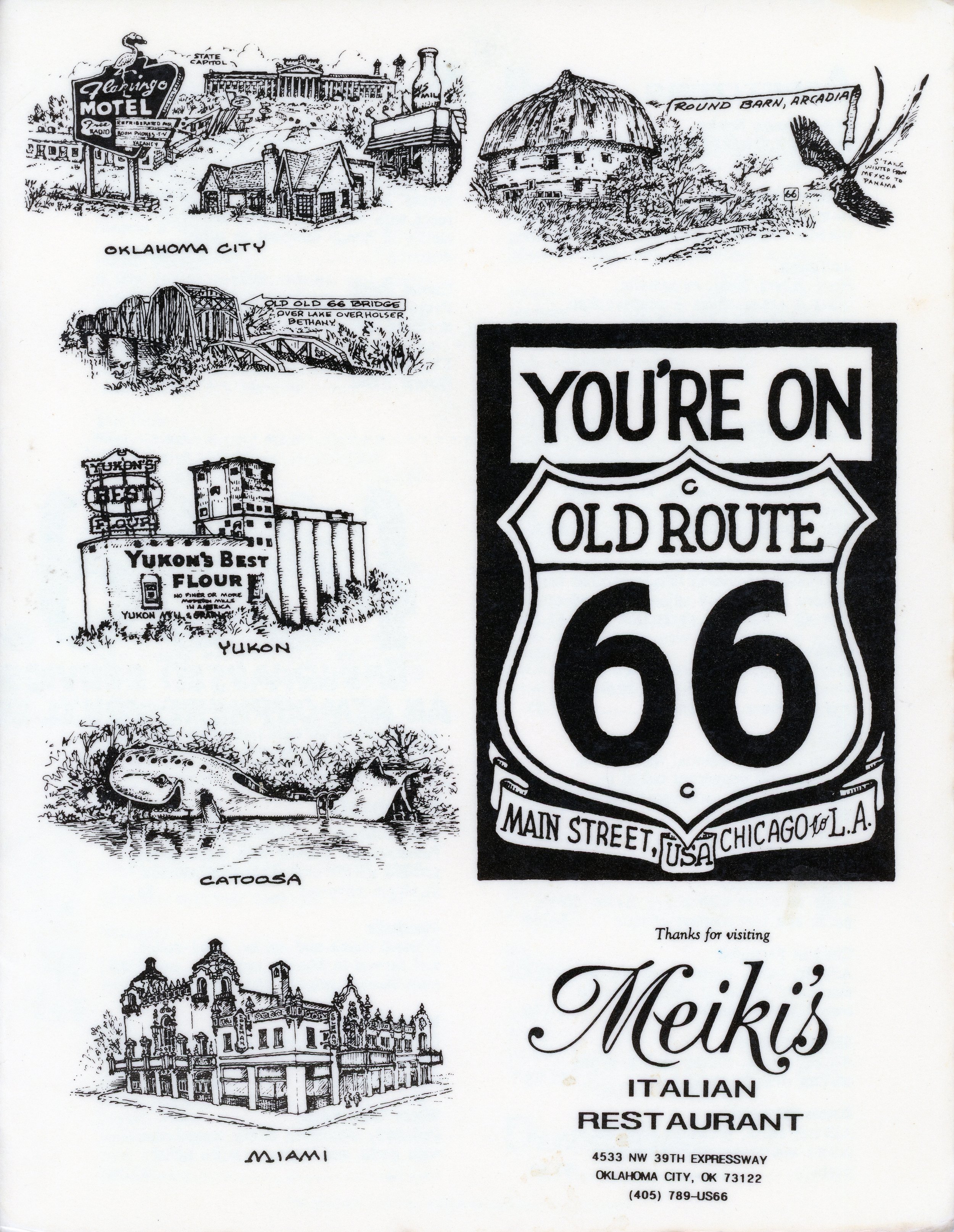
Menu cover for Meiki’s Italian Restaurant in Oklahoma City, featuring several of Bob’s sketches.
If you talk to people that were a part of the roadie family back then, most of them have a story of encountering Bob at an event or out on the road. “I remember one late night, Denny's was the only late night restaurant in Holbrook,” remembered Cindy Jaquez, owner of the Jackrabbit Trading Post in Joseph City, Arizona. “We went in at almost midnight and there was Bob sitting alone…working on his art for some business. He was a great friend.” Trond Moberg, who served as President of the Norwegian Route 66 Association and led groups of travelers for many years, recalled, “When I was on tour and spotted Bob’s Volkswagen bus outside Denny’s, I usually stopped for a chat. During one four month season I met him at Denny’s in Tucumcari, Winslow, Kingman and Flagstaff. In Tucumcari I took the whole group of 32 motorcycles to Denny’s for lunch and Bob had a show and tell outside his bus. I remember he sold lots of postcards.”
One occasion stands out to author and historian Michael Wallis. He had stopped at the ghost town of Glenrio, which straddles the Texas and New Mexico state line. Tiny vehicles zooming past on Interstate 40 in the distance are typically the only sign of life at this once-bustling border crossing. But on this day, something else stirred.
I pulled in on my Harley for the usual inspection of derelict buildings. When I walked back to my bike, I thought I heard…laughter. Coming to me on the breeze. I stopped, listened again, and heard more. It sounded like someone was conversing and seemed to be having a good time. It came from down where the old road is full of weeds and broken up, that goes westward into New Mexico. So I walked over this little hillock, and I saw my old pal, Bob Waldmire. Bob was wearing his usual bandana tied around his head, a pair of baggy cargo shorts, and sandals. And he was lying prone on his back! He was holding above him, what appeared to be a fairly good-sized desert tortoise. The tortoise looked like it was fairly content. Bob was talking to the tortoise, and every once in a while, he’d give it a laugh. They were in deep conversation. My inclination was to go down and see my old buddy, but then I thought about it. I thought, ‘You know what? I’m not going to intrude.’ I told myself I was going to look at it, and memorize it, and take off. I always have that image of Bob and that tortoise; it’s always there in my mind whenever I want to pull it up. And I always smile.
Even the crew at Pixar Animation Studios was impressed with Bob’s story and his presence on the route. When they were creating the movie Cars, they asked him if they could name their hippie Volkswagen bus character after him; after all, he was the direct inspiration! Bob, still a strict vegetarian, didn’t want his name to be tied with any kind of fast-food merchandising…so he declined. But there was no bad blood; in fact, Bob would later make a drawing of his famous camper van meeting Fillmore of Radiator Springs somewhere on old Route 66.
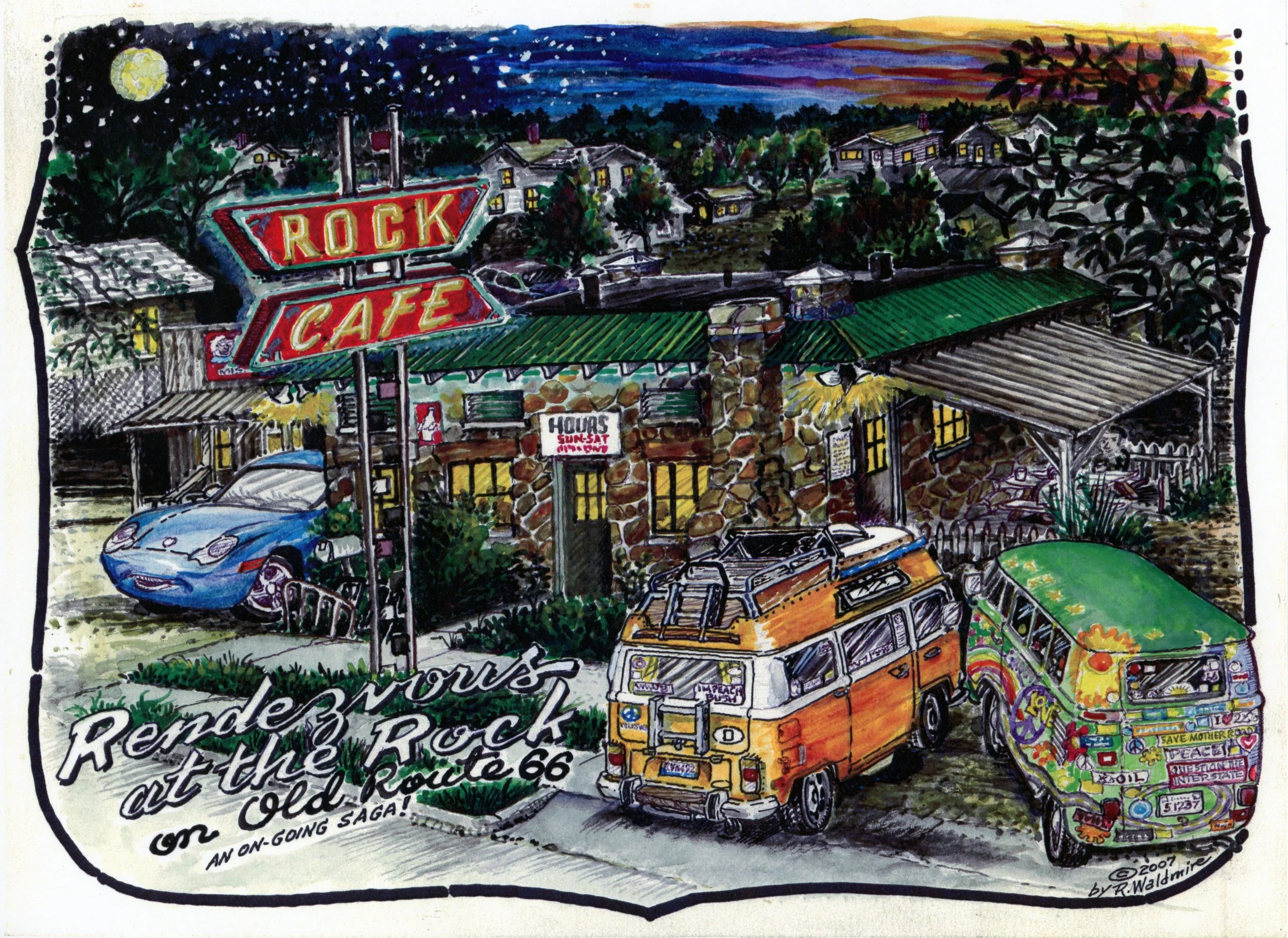
Bob Waldmire, Rendezvous at the Rock on Old Route 66, 2007
Things seemed to be on the upward swing for Bob and his craft. He continued creating new art, capturing historic sites, small-town life, and all manner of natural wonder. He created a new color map of Route 66 and put together an entire calendar dedicated to the 40th anniversary of the Ford Mustang. At the International Route 66 Festival in Tulsa, Oklahoma in 2004, Bob was awarded the Steinbeck Award for his years of advocacy. He had his first formal art show at Clinton’s Oklahoma Route 66 Museum in the summer of 2006; people came from all over to see Bob and check out his latest work. His Mustang was on display in the museum, too, which by then featured a beautiful mural map of Route 66 down the hood stripe complete with hundreds of signatures from across the road. In his 2006 Dispatch, Bob called the show the “crowning glory” of his artistic career.
But the people that knew him best began to see a change in him. Something wasn’t right; Bob was sick. He knew it. But he had decided to approach it the same way he had approached the rest of his life: with peace, strength, and quiet grace. He let it take its course and continued with the itinerant life he loved. He bought a retired U-Haul truck and painted a mural on the side with a plan to raise money by selling it. He continued to build out his homestead in Portal, Arizona. And, still, he created new sketches of the world around him.
In October of 2009, Bob finally made a public announcement: he had cancer. By that time it had spread throughout his body; his time was almost at an end. A month later, Bob’s Last Art Show took place at the Cozy Dog in Springfield, Illinois. People came from as far away as Japan to see him one last time. They expressed their love for a man that had become as much a part of Route 66 as the pavement itself. Bob wasn’t sad; he was grateful.
On December 16th, 2009, Bob passed away peacefully. He was 64.
Per his wishes, his ashes were spread at multiple sites across the country, including several along Route 66. Laurel Kane, a Route 66 advocate and business owner in Afton, Oklahoma, was a dear friend of Bob’s and one of the recipients of his ashes. On a breezy October afternoon, Laurel and her family went out to the side of the old road itself and let Bob’s cremains scatter to the wind. The wayward artist and conservationist from the Land of Lincoln had become a part of road itself, returned to the earth that he respected so dearly.
Make it stand out
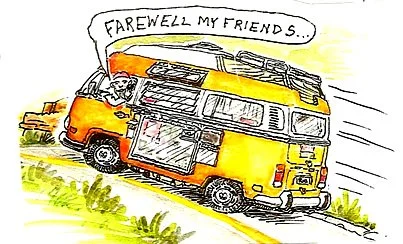
Bob Waldmire, Farewell My Friends (courtesy of Johnnie Meier)
Bob Waldmire’s legend continues to grow more than a decade after his death.
The Cozy Dog Drive-In in Illinois still sells his artwork, both locally and wholesale to shops up and down the road. The Route 66 Museum in Pontiac, Illinois is the home of his beloved Volkswagen camper and his converted school bus. The Hackberry General Store, more of a traditional gift shop these days, still welcomes legions of travelers. Bob’s murals are still visible on walls throughout the Route 66 corridor. And, if you look closely at some newer works, you may see a small, bearded hippie standing around or an orange Volkswagen van zipping around.
The U-Haul truck Bob was working on never sold – in fact, it was still technically still owned by Ken Clark of Tulsa, a friend that had been helping him install his wind turbine system in Arizona. After Bob’s passing, Ken donated the truck to the Route 66 Museum in Elk City, Oklahoma…but they didn’t have room for it. It made a trek up to Afton, Oklahoma and was on display there for years as part of Laurel Kane’s Packard museum. After Laurel passed, the Oklahoma Route 66 Association took possession of the truck, and they are working to restore it to running order for the Centennial in 2026.
Every day, people from around the world come to Route 66 to experience the story of America. Although they will never get a chance to meet Bob Waldmire in the flesh, they will come to know him by his work and the stories that are still told of an incredible human being that loved the journey more than the destination.
The next time you’re cruising the old two-lane and see a turtle trying to cross, pull over and give him a helping hand. Think of Bob and the closing words to many of his hand-written letters:
“For the Earth.”